Why Index Price Levels Don't Tell the Full Story
May 11, 2026

How the Defender Risk Adaptive 500 ETF (SPDF) Responds to Changing Market Conditions
Why Look Beyond Index Price Levels?
Broad equity indexes can, at times, mask differences beneath the surface.
Market capitalization-weighted indexes, such as the S&P 500 Index, are influenced heavily by their largest constituents. As a result, index-level performance may reflect the strength of a relatively small group of stocks, even when a larger portion of the market is experiencing weaker trends.
This dynamic can create periods where headline index performance appears resilient while underlying participation across individual securities declines. Evaluating additional measures of market activity may help provide context around overall market conditions.
For this reason, the Defender Risk Adaptive 500 ETF (SPDF) incorporates market breadth indicators as part of its investment process.
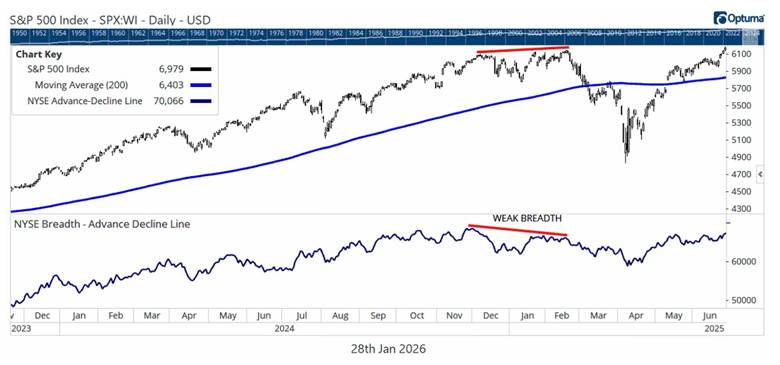
Chart: S&P 500 vs. NYSE Advance-Decline Line, early 2025 — this demonstrates growing market fragility well BEFORE the tariff-related meltdown.
The Lens: Looking Beneath the Surface of the Market
Market breadth indicators evaluate participation across individual securities rather than focusing only on index prices. By examining how widely market movements are supported, breadth provides additional context around overall market conditions and potential risk.
The Objective: Balanced Participation with Risk Awareness
The Fund's objective is to participate in equity markets when conditions appear supportive while seeking to reduce exposure during periods of elevated risk.
This approach is designed to emphasize:
- Disciplined, rules-based decision-making
- Responsiveness to changing market conditions
- Risk awareness across market cycles
The Process: Systematic, Quantitative, and Adaptive
SPDF seeks to provide exposure to U.S. large-cap equities while incorporating a systematic risk management approach informed by quantitative market breadth indicators. The Fund primarily invests in broad U.S. equity ETFs and uses measures such as advance-decline data, trend participation, and new high/new low activity to evaluate overall market conditions.
Based on these indicators, the investment process classifies market conditions into defined risk environments and adjusts portfolio exposure accordingly. Equity exposure may be increased or reduced in response to changing conditions, and in certain circumstances the Fund may allocate partially or fully to U.S. Treasury or high-quality short-term fixed income ETFs.
 Download PDF